06:17 pm

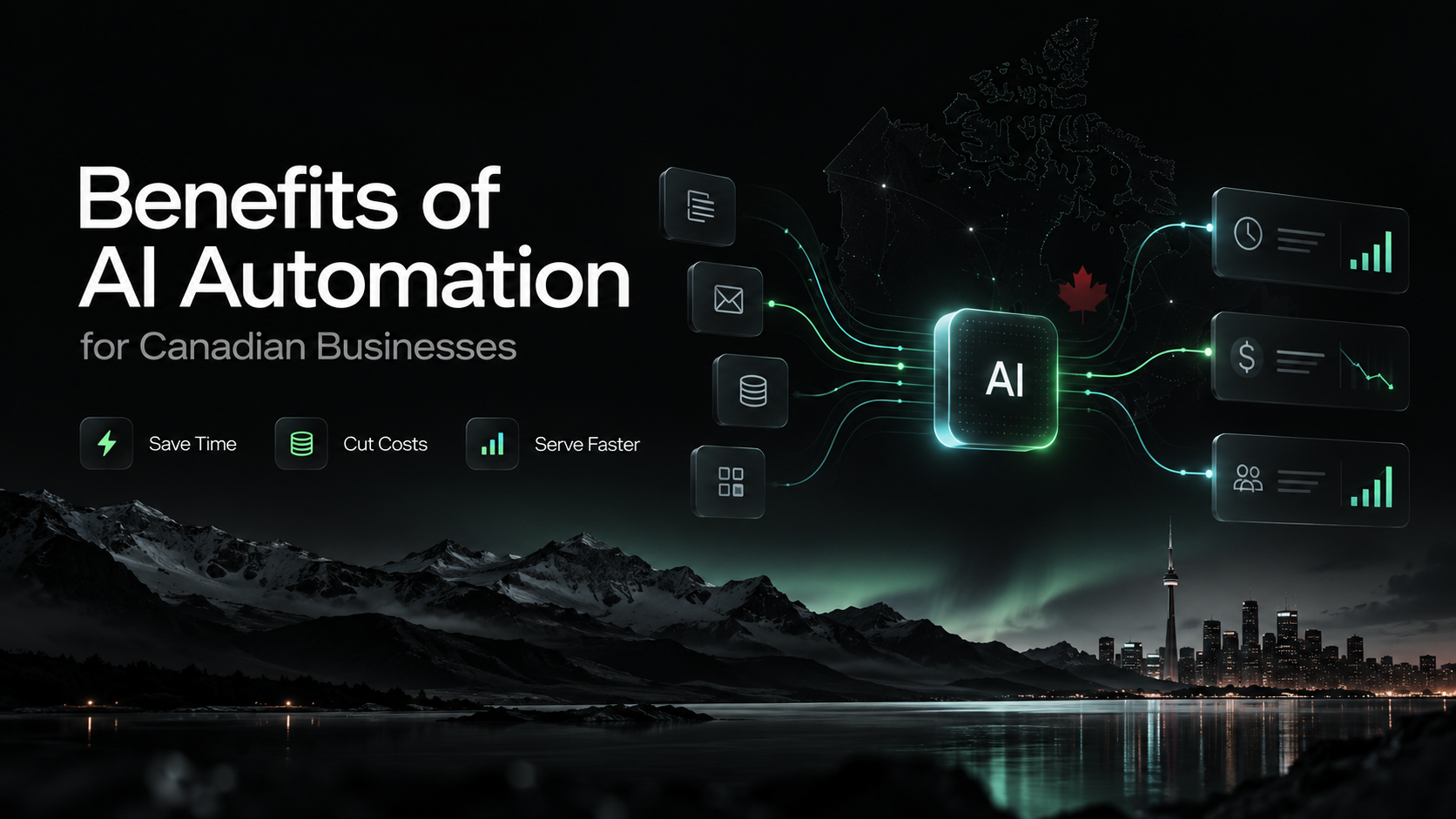
The primary benefits of AI automation for Canadian businesses are saved staff hours, lower costs, faster customer service, more marketing output and better decisions.
By Shardar Quraishi, Founder & CEO, Aurixlab
Last updated: October 14, 2026
The primary benefits of AI automation for Canadian businesses are saved staff hours, lower costs, faster customer service, more marketing output and better decisions. Statistics Canada reports that 19.2% of businesses used AI to produce goods or deliver services in the year before Q2 2026. That is triple the 6.1% of 2024.
In a 2024 BDC survey of 1,247 owners, 97% of AI-using SMEs reported tangible benefits. KPMG Canada found that 54% of employees who use generative AI save 1 to 5 hours a week.
The advantages of AI in business are uneven, though. Firms with clean data, cloud tools and trained staff gain the most. Aurixlab, a Calgary-based growth agency, built this guide on Statistics Canada, BDC, KPMG and federal sources.
AI automation saves most Canadian generative AI users 1 to 5 hours a week. In KPMG's 2025 index of 2,239 workers, 54% of users reported that range and 79% said AI improved their productivity. CFIB's 2025 study found that SMEs using generative AI saved an average of 1.08 hours per day.
Task-level AI productivity gains run larger. The Future Skills Centre and Diversity Institute June 2026 report on AI in SMEs documents two company-reported cases:
AI cost savings show up for about a quarter of AI-using SMEs. In BDC's 2024 study, 27% of AI users reported lower operating costs. Another 22% reported a reduced need for new hires.
The Future Skills Centre report records Pièces d'autos Fernand Bégin cutting labour costs by 15%. BDC reports that Foothills Group (ShopView) used AI-driven systems to turn a $1M loss into a $2.7M profit in one year. CFIB found SMEs earned $1.60 for every $1 invested in technology, including AI.
AI automation improves customer service by answering routine questions and booking appointments at any hour. Chatbots and virtual agents are the third most common AI use in Canada, at 28.2% of adopters. In a Salesforce and Angus Reid Forum study from May 2025, 55% of Canadians said channel matters less than a quick fix.
An AI chatbot for business and an AI appointment booking form both live on your website. That is why conversion-focused website builds affect how many after-hours visitors book.
AI receptionists work for after-hours calls, common questions and bookings, and callers resent them when no person is reachable. SurveyMonkey's December 2025 poll of 2,017 US adults found 79% strongly prefer human agents.
A 2024 Gartner survey of 5,728 customers found 64% would prefer companies didn't use AI for customer service. Their top concern was reaching a person.
Set up an AI receptionist with three rules:
AI marketing automation helps Canadian firms produce more content and follow up with leads faster. Marketing automation is used by 19.8% of AI-using businesses, per Statistics Canada.
In a 2025 TD and Ipsos poll of 400 small business owners, almost half used AI for marketing content. JENNY BIRD raised average order value by 58% after adding AI personalization, per the Future Skills Centre report.
AI lead generation starts with being found, which is the focus of Aurixlab's local and AI search visibility work. Content is the other input. AI-assisted video and photo production turns one shoot into many posts and ads.
AI applies first to repetitive tasks with clear inputs: data entry, scheduling, invoices, inbound questions and follow-ups. Automate the task that takes the most staff hours and holds the least personal data. AI invoice processing and AI appointment booking make good first projects, if each follows the same steps every time.
Data analytics is the top AI use in Canada, at 36.6% of adopters. AI-based decision-making systems reached 13.7% in 2026, up from 5.7% in 2025. Patates Dolbec raised sorting accuracy to 95%, up from 70%, with AI quality control, per the Future Skills Centre.
AI business automation comes in layers. Business process automation runs fixed rules. AI workflow automation adds a language model that reads documents, and intelligent automation combines the two.
AI agents for business complete multi-step tasks. In a 2025 KPMG survey of 252 Canadian businesses, 27% had deployed agentic AI. For a task list and rollout steps, see Aurixlab's small business automation guide.
AI automation in Canada mostly changes tasks and training, and replacement is the less common outcome. Statistics Canada found 44.4% of AI-using businesses changed training or staffing because of AI, and 32.0% trained existing employees. StatCan says AI's employment impact "remains unclear."
In KPMG's 2025 agentic AI survey, 72% of leaders said their employees were concerned about replacement by agentic AI. Yet 89% expected agentic AI to fill labour or skills gaps. Aurixlab covers role-by-role exposure in its post on AI and white-collar jobs.
Some Canadian employers are rehiring. Canadian HR Reporter's May 2026 coverage cites a Robert Half survey. In it, more than a third (34%) of hiring managers who cut roles after adopting AI later re-added those or similar roles.
Robert Half has not posted that figure in its press room. Its own AI hiring research shows 48% of 1,500 Canadian business leaders expect their department's AI use to drive additional hiring in 2026.
Some businesses see no benefit because AI pays off mainly on top of good data, cloud tools and trained staff. A Statistics Canada study from April 2026 found AI adopters were 16.8% more productive. The premium fell to 10.2% after accounting for earlier productivity.
With complementary capabilities added, it fell to 5.1% and was no longer statistically significant. The study used 2019 and 2021 data, before generative AI spread.
In Zensurance's September 2026 survey of 1,000 self-employed Canadians, 32% said AI had little to no impact. Across Canadian organizations, only 3% report established, measurable AI ROI, per KPMG.
The fix is groundwork. Firms using data analytics were 15.0 percentage points more likely to adopt AI, per the same StatCan study.
In Deloitte Canada's 2026 survey of 300 senior leaders, 59% cited data quality as a barrier. Clean up records, move core files to cloud tools and train staff before buying more software.
Information, finance and professional services firms are best placed, because they already use AI most. StatCan's 2026 adoption rates are 42.3% in information and cultural industries, 40.4% in finance and insurance and 32.4% in professional services. Construction sits at 9.2%.
Other industries are catching up. In StatCan's Q3 2026 planning survey, planned AI use in construction reached 18.3%, up from 3.2% in 2024.
AI adoption in Canada also varies by size and place. Firms with 100 or more employees use AI at 27.8%, against 19.9% for firms with 1 to 4.
Use of AI in Canadian business is higher in cities: 21.0% urban against 9.9% rural. Urban rates are the closest guide for AI automation in Toronto, Vancouver, Calgary, Montreal and Ottawa.
Definitions matter. StatCan counts AI used to produce goods or deliver services. BDC says only 30% of SMEs currently use generative AI (February 2026 survey).
Microsoft Canada counts any AI use and reports 71% of 300 SMBs. These AI statistics for Canada measure different things.
A starter AI automation stack costs a small Canadian business about C$100 a month: two AI assistant seats and one automation tool. Most AI for business tools are priced in US dollars or euros. The table shows AI automation pricing at the Bank of Canada rate of 1.4222 on October 13, 2026.
Tool or service
Listed price
Approx. monthly cost in CAD
ChatGPT Business, per user, monthly billing
US$25
C$35.56
Zapier Professional
from US$19.99
C$28.43
Make Core, monthly billing (Jetadmin)
US$10.59
C$15.06
n8n Starter, annual billing
€20
billed in euros
AI receptionist (ChatGPT.ca vendor guide)
C50toC150
C50toC150
Most AI for small business in Canada starts with subscriptions like these. Outside help raises the AI automation cost. Published AI consulting cost ranges run $150 to $400 an hour, per Get Clear.
First small-business projects run $5,000 to $15,000, per ChatGPT.ca. Both sources sell these services.
A simple AI automation pays for itself in about 5 to 11 months with a $5,000 setup fee. A do-it-yourself build pays off from month one. This example uses the Job Bank median wage for administrative assistants, $26.44 an hour:
The wage excludes payroll costs, so this AI automation ROI estimate is conservative. In KPMG's 2025 survey of 753 large-firm leaders, 8% expected ROI within 6 months.
Set it up yourself for single-app tasks, and hire help for multi-system workflows, customer data or funded projects. Small firms mostly go alone. Only 10.7% of AI users with 1 to 4 employees used external consultants or vendors, against 30.2% of firms with 100 or more.
AI consulting in Canada fits PIPEDA or Law 25 work and BDC LIFT applications, which require an advisory plan. Compare AI automation services in Canada on scope and data handling. Ask any AI automation agency for a fixed-scope first project.
Zapier is the easiest to learn, Make is the cheapest hosted option, and n8n suits teams that want to self-host. On Zapier vs Make, Make Core costs about half as much: US10.59againstUS19.99 a month. Zapier accepts several currencies, including CAD.
Make is quoted in US dollars and n8n in euros. Self-hosting n8n in Canada keeps workflow data on servers you choose.
Yes, but most AI funding in Canada is a loan or a tax write-off, not a grant. BDC LIFT launched April 24, 2026 with $500 million for more than 1,000 SMEs. Loans run between $25,000 and $5 million.
The AI and digital track requires at least $1 million in annual revenue and a BDC Advisory Services plan. BDC offers a preferential rate when a Canadian supplier provides or integrates the technology. BetaKit reported that rate as 2.25% at launch, so confirm it with BDC.
The Canada Digital Adoption Program closed to new applications on February 19, 2024. The proposed Productivity Mega Deduction, announced by the Prime Minister's Office on September 15, 2026, would allow immediate expensing of software and computer equipment. It is draft legislation, not yet law, per Fasken.
AI grants in Canada are small and regional. Nova Scotia's AI Digital Adoption Program offered up to $8,500 plus HST but is closed. The federal AI for All strategy targets 60% business AI adoption by 2034.
The main rules are PIPEDA, Quebec's Law 25, Quebec's French-language charter and liability for what your chatbot says. Federal AI privacy in Canada still rests on PIPEDA.
Bill C-36, its proposed replacement, has only had first reading, on June 15, 2026. As tabled, it proposes penalties up to the greater of $10 million or 3% of global revenue, per Fasken.
No AI tool is PIPEDA compliant on its own, because PIPEDA duties fall on your business. The PIPEDA and AI question comes down to prompts. The OPC's generative AI principles say to limit personal information in prompts and use de-identified data where possible.
Keep identifiable customer data out of free chatbot tiers. ChatGPT Business does not train on business data by default, per OpenAI.
No, PIPEDA does not require data to stay in Canada. The OPC's cross-border guidance allows processing abroad when a contract gives comparable protection and customers are told. OpenAI offers Canadian data residency for ChatGPT Enterprise and Edu.
Anthropic offers Canadian regional deployment of Claude through AWS Bedrock and Google Cloud Vertex. More AI compute is coming to Canada too, including Meta's $13B Alberta data centre.
Law 25 requires businesses to tell people when a decision is based exclusively on automated processing of their personal information. Under section 12.1, people can ask for the main factors behind it. They can also submit observations to a staff member who can review the decision, per BLG.
Quebec's French-language charter gives consumers the right to be served in French, per Gowling WLG. Plan a French chatbot for Quebec customers.
The business is liable. In Moffatt v. Air Canada (2024 BCCRT 149), the BC Civil Resolution Tribunal held Air Canada responsible for its website chatbot's negligent misrepresentation.
It ordered Air Canada to pay $812.02 and rejected the claim that the chatbot was a separate legal entity, per Mondaq. Have staff check chatbot answers on prices and refunds before launch.
Yes, AI automation is worth it for repeatable, high-volume tasks. BDC found 97% of AI-using SMEs reported tangible benefits in 2024, and most generative AI users save 1 to 5 hours a week (KPMG). Results depend on data and training: 32% of self-employed Canadians saw little to no impact (Zensurance, 2026).
19.2% of Canadian businesses used AI to produce goods or deliver services in the 12 months before Q2 2026, according to Statistics Canada. That share was 12.2% in 2025 and 6.1% in 2024. Another 25.2% of businesses plan to use AI in the next 12 months.
No, BDC LIFT is a loan program. It lends $25,000 to $5 million to SMEs adopting AI, at a preferential rate when a Canadian supplier provides or integrates the technology. The AI track requires at least $1 million in annual revenue and a BDC Advisory Services plan.
No, CDAP closed to new applications on February 19, 2024. BDC does not permit extensions and now directs businesses to its LIFT offer for preferential-rate consulting and financing. Provincial grants are small, and Nova Scotia's AI Digital Adoption Program is also closed.
No, Bill C-36 is a proposed law at first reading. It was introduced in the House of Commons on June 15, 2026, and has not reached second reading. PIPEDA remains the federal private-sector privacy law until a replacement passes and comes into force.
Yes, disclose AI customer service as standard practice. The OPC's generative AI principles tell organizations to inform people when they are interacting with a generative AI tool. Law 25 adds notice in Quebec for fully automated decisions, and 14% of US adults in SurveyMonkey's poll would lose trust over undisclosed AI.
Start with one repetitive task, time it now, automate it and compare after 90 days.
Aurixlab works as a one-stop growth partner for Canadian businesses. Websites, content, search and automation run as one system. To map your first project, book a call with Aurixlab.